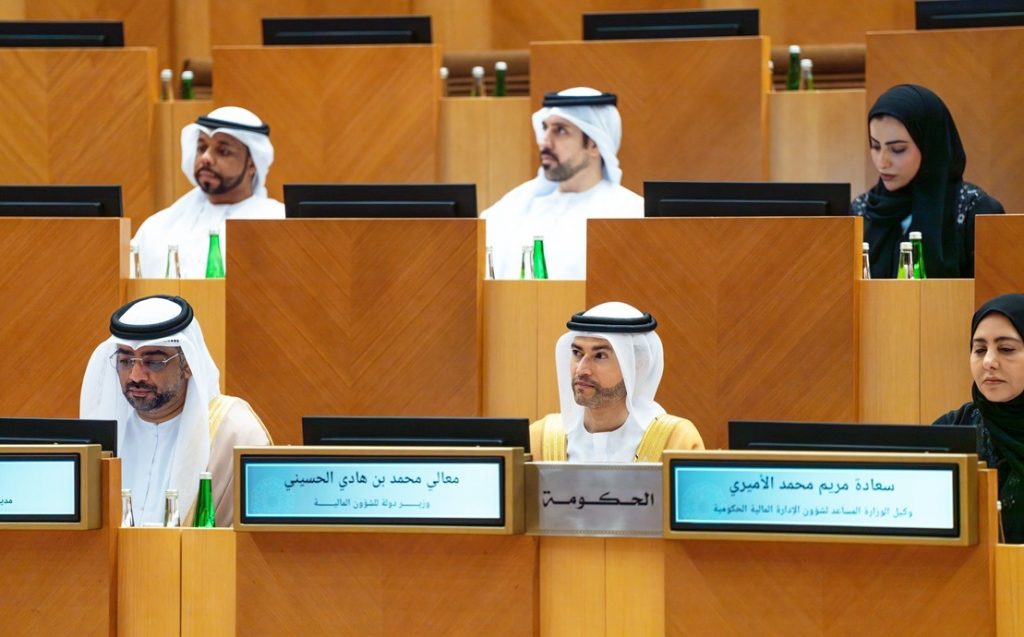
The Federal National Council (FNC), chaired by H.E. Saqr Ghobash, Speaker of the Council, convened a session as part of its regular sitting of the Eighteenth Legislative Chapter at Zayed Hall at the Council’s headquarters in Abu Dhabi. During the session, the Council reviewed a draft federal law approving the UAE’s Unified Final Accounts (Consolidated Financial Statements) for the fiscal year ended December 31, 2025. The session was attended by H.E. Mohamed bin Hadi Al Hussaini, Minister of State for Financial Affairs.
H.E. Mohamed bin Hadi Al Hussaini underscored the vital role of the Federal National Council in supporting sound financial governance and promoting the principles of transparency and accountability. He expressed his gratitude to the Council’s leadership and members for their efforts in reviewing the draft law and examining its outcomes, noting that such collaboration contributes to the continued development of the federal financial system and supports the achievement of the UAE’s sustainable development objectives.
His Excellency further highlighted that throughout 2025, the Ministry of Finance continued to strengthen public financial management and advance sustainable development through the effective stewardship and growth of federal government resources. The Ministry also continued to enhance government financial reporting and data systems, elevate the quality of financial disclosure, and improve expenditure efficiency, supporting sustainable economic growth and contributing to the UAE’s strong sovereign credit profile. These achievements, he noted, have been driven by the UAE’s ambitious leadership vision, a resilient economy, and a government ecosystem capable of adapting to an evolving global landscape and transforming challenges into opportunities.
Diversified Government Revenues Drive Strong Financial Performance
Total federal government revenues reached approximately AED 86.3 billion in 2025, reflecting a diversified revenue base comprising operational revenues generated by federal entities, tax revenues, and contributions from local governments.
Operating revenues accounted for AED 53.6 billion of the total, primarily generated through government service fees. Key contributors included fees associated with the issuance of Emirates ID cards, entry visas and residency permits, work permits and labour cards, certificate attestation and official document issuance services, licensing of commercial agencies and business establishments, permits for conducting commercial activities, as well as medical treatment fees.
Strategic Expenditure Supports National Priorities and Quality of Life
Total federal government expenditure reached approximately AED 68.9 billion in 2025, underscoring the UAE’s continued commitment to directing public resources toward national priorities and advancing sustainable development. Employee salaries and benefits accounted for AED 29 billion of total expenditure, while 5,370 employees were appointed during the year, bringing Emiratisation levels across the federal government workforce to 65 percent.
Spending on General Public Services amounted to AED 19.3 billion, supporting the delivery of government programmes, administrative services, and initiatives aimed at enhancing institutional efficiency and public sector performance. Education expenditure reached AED 16.3 billion, reflecting the UAE’s ongoing investment in strengthening the national education system and elevating the quality of educational services.
Expenditure on Public Order and Safety totalled AED 8.1 billion, reinforcing efforts to enhance security, maintain social stability, and further develop operational capabilities across relevant entities.
Social Protection spending amounted to AED 7.1 billion, while the healthcare sector received AED 5.6 billion to support the continued delivery of high-quality healthcare services and medical care. Economic Affairs expenditure reached AED 2.3 billion, including AED 1.2 billion allocated to infrastructure investments aimed at developing, upgrading, and maintaining government facilities and public services.
Continued Investment in Housing and Community Wellbeing
The federal government reaffirmed its continued commitment to supporting the housing sector as a cornerstone of family wellbeing and social stability, with expenditure reaching AED 2.9 billion in 2025. Spending on recreation, culture, and religious affairs amounted to approximately AED 1.4 billion, reflecting the government’s broader efforts to enrich community life and preserve cultural and social cohesion.
Environmental protection expenditure reached AED 307 million, reflecting the government’s commitment to preserving natural resources, advancing environmental sustainability, and enhancing quality of life across communities.
Strong Federal Financial Position
According to the UAE’s consolidated financial statements, total federal government assets stood at approximately AED 569.8 billion as of December 31, 2025, underscoring the strength of the federal government’s financial position.
The federal government also maintained a diversified investment portfolio valued at AED 24.9 billion, managed through the Emirates Investment Authority, reflecting a balanced approach to investment and wealth preservation.
Property, Plant and Equipment (PPE) assets totalled approximately AED 60.4 billion. This included AED 41.2 billion in buildings, land and related improvements, AED 9.3 billion in infrastructure assets, AED 7.9 billion in projects under construction, and AED 2 billion in furniture, equipment and devices.
Advancing Financial Reporting, Digital Transformation, Innovation and Sustainability
The session also highlighted a number of key achievements delivered during the 2025 fiscal year, including the Ministry of Finance’s successful implementation of new international accounting standards that further enhanced government financial reporting, strengthened transparency, and elevated the quality of financial disclosure. The adoption of these standards contributed to the recognition of government assets worth AED 761 million, while the implementation of the Financial Instruments Standard enhanced risk management practices through the adoption of the Expected Credit Loss (ECL) model in line with international best practices and standards.
As part of the government’s digital transformation agenda, more than 109 strategic objectives and initiatives were implemented, with total expenditure reaching approximately AED 2 billion and an execution rate exceeding 91 percent. Automation initiatives also played a significant role in enhancing operational efficiency and improving the quality of government services.
In the area of innovation, more than 72 objectives and initiatives were delivered with total expenditure of AED 93.1 million and an implementation rate exceeding 99 percent, supporting the growth of the knowledge economy and reinforcing the UAE’s global competitiveness.
The government also continued investing in environmental sustainability and resource security through delivery of 19 initiatives and projects valued at AED 181 million, achieving an execution rate of more than 98 percent. These efforts contributed to strengthening water and energy security while supporting the development of sustainable infrastructure.
Concluding the presentation of the consolidated financial statements, H.E. Mohamed bin Hadi Al Hussaini reaffirmed that, under the guidance of the UAE’s wise leadership, the Ministry of Finance remains committed to advancing an integrated financial framework built on efficient resource management, sound fiscal sustainability, and balanced economic growth. He noted that this approach continues to support the UAE’s comprehensive development objectives while further strengthening its position among the world’s most competitive, innovative, and future-ready economies.